According to TrendForce, the independent new energy research agency, cumulative shipments of 210mm modules?have exceeded 120GW, and the power of 210mm n-type modules?has passed 700W.?TrendForce estimates in its recent report that in 2023, large-format wafers, cells and modules will account for more than 90% of the total production capacity, and demand for large-format products will demonstrate a strong growth.
Production capacity will exceed 90%, with 210mm modules accounting for nearly 60% of total production capacity
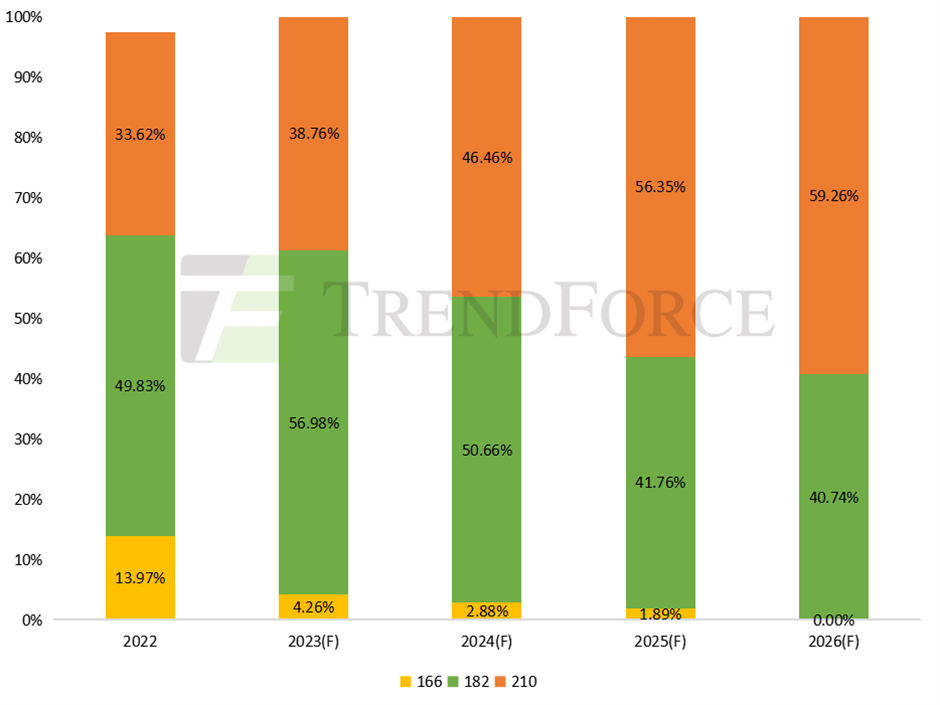
In terms of wafers, TrendForce expects a faster increase in demand for large-format wafers?in 2023, with its market share increasing rapidly from 83.45% in 2022 to 95.74%. In 2023, the production capacity for large-format wafers will hit 792.4GW,?showing a stronger tendency toward larger formats, while 210mm wafer production capacity will hit 320.8GW, increasing by 74.6%, with a market share of 38.76%.?
Figure: Capacity ratio for wafers of different sizes between 2022 and 2026 (Unit: %)
?
(Source: TrendForce)
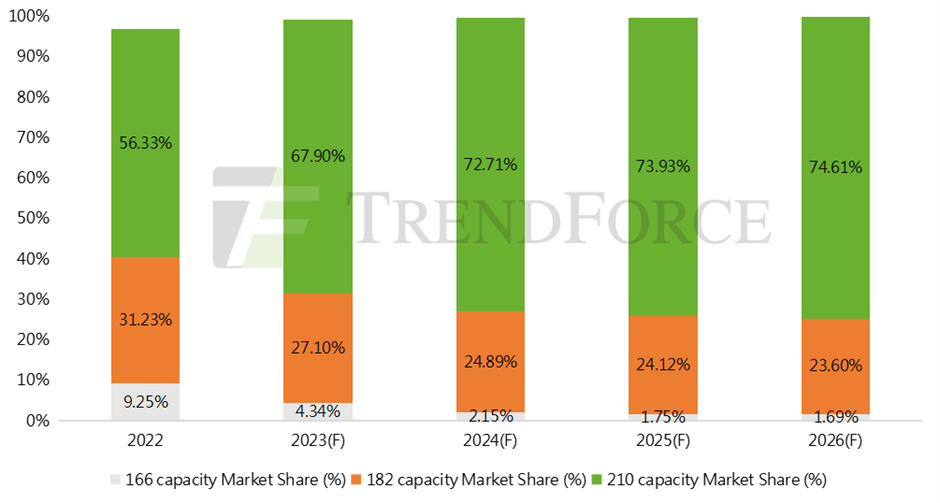
In terms of cells, the capacity for large-format cells will reach 822.3GW in 2023, accounting for 94.99% of total capacity. 210mm cell capacity will reach 587.75GW, an increase of 83.7% from 2022, with a market share of 67.9%.
Figure: Capacity ratio of large-format cells (Unit: %)
?
(Source: TrendForce)
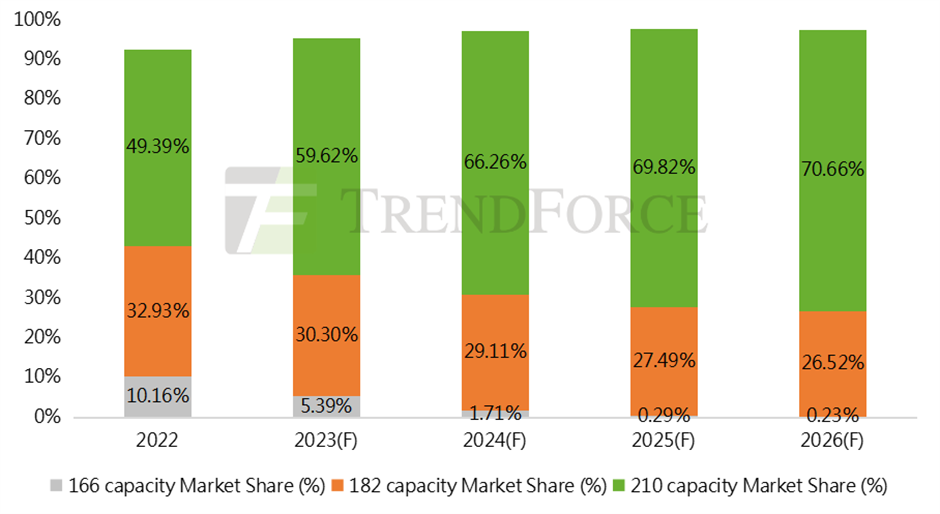
On the module front, TrendForce anticipates a significant increase in production capacity for large-format modules in 2023, reaching 767 GW with a market share of around 90%.?Among them, 210mm module capacity will reach 508GW, a 68.14% increase from 2022, with a market share of 59.62%, indicating continued strong growth.
Figure: Market share of modules (Unit: %)
?
(Source: TrendForce)
Bidding trends: High power modules dominate, with large-format modules accounting for 89.21%
In terms of bidding trends, projects clearly favor large-format modules. According to TrendForce, high power modules are in demand among the nearly 129GW centralized procurement of PV modules announced by COEs and SOEs in 2022, with large-format modules dominating. Over 115GW of the bidding projects specifically require 182/210mm modules, accounting for 89.21%, indicating an increasing demand for large-format modules, which is a key component of the industry chain for reducing costs and increasing efficiency.
The shipments of the first-tier module manufacturers?in 2022 all exceeded 40GW, and the cumulative shipments of 210mm modules exceeded 120GW
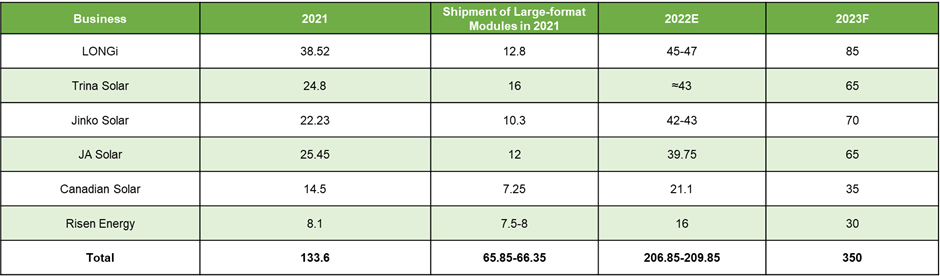
According to TrendForce, the top six module manufacturers’ shipments in 2022 were around 205-211GW, accounting for 76-78% of the annual module demand of 270GW. Among them, LONGi, Trina Solar and JinkoSolar all shipped more than 40GW.?In 2022, shipments of large-format modules grew at a faster rate, accounting for more than 80% of total shipments. As of the first quarter of 2023, the cumulative shipments of 210mm modules had exceeded 120GW.?Shipments of large-format modules will continue to rise as market demand and production capacity expand.
Figure: Shipments of leading module manufacturers?(Unit: GW)
?
(Source: TrendForce)
Technology development: the combination of 210mm and n-type technology supports module power output to exceed 700W
The combination of large-format and n-type technology has become an inevitable trend. The power of 182mm n-type modules increases from 500W+ to 600W+, while the power of 210mm n-type modules exceeds 700W.
With the large-format products develop rapidly and advanced technologies such as n-type mature, 210mm products have already become the mainstream in the PV industry and will continue to dominate the market.